Preschools play key role in preparing English learners for kindergarten
 Sarah Tully, EdSource
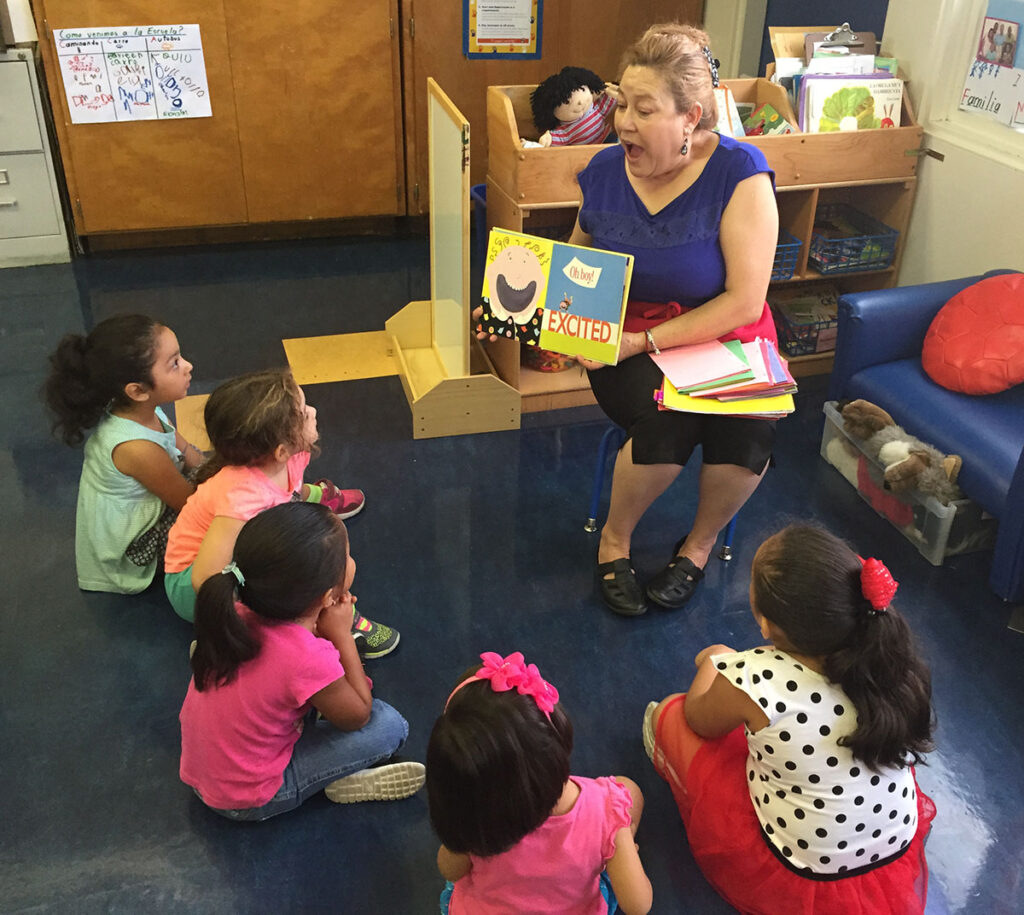
Instructor Marisol Garcia Del Ruiz holds upwardly a book in English and demonstrates the words for emotions in Castilian at a Caput Kickoff class in Norwalk in September 2015.
 Sarah Tully, EdSource
Instructor Marisol Garcia Del Ruiz holds upward a book in English language and demonstrates the words for emotions in Spanish at a Head Start class in Norwalk in September 2015.
When Laurel Parker, who directs preschool programs in the Norwalk-La Mirada Unified School District southeast of Los Angeles, assigns children to classes, she knows most come in speaking a language other than English at dwelling.
What happens next is central to a major claiming facing California education: how to brand sure that preschool children with limited English-speaking abilities enroll in kindergarten prepare to learn.
Information technology is a goal that experts say preschool programs beyond the state have simply partially been able to fulfill.
Laurie Olsen, a long-time researcher and expert on English language learners who directs the Sobrato Early Academic Linguistic communication Initiative, said that providing access to quality preschool should be a major part of any strategy to shut disparities in school readiness. "That'south true for all children," she said. "Merely it's particularly true for children who are coming to our school systems from homes where English is non their home language."
She said that awareness of preschool's role is growing, merely that California still has a long way to go. "We're really far behind in mounting the kinds of programs and services that are needed" for English language learners, she said.
The challenge facing the state in full general was axiomatic in student scores on the Smarter Counterbalanced assessments
nts released in September. Two-thirds of English learners in grades iii through 8 and grade 11 failed to meet the standard on the assessments, falling into the lowest of four achievement levels on the tests.

Sarah Tully, EdSource
Diego Sandoval, correct, and Giovanny Andres play an English and phonics game on the reckoner during a Head Start class in Norwalk on Sept. 14, 2015.
Preschools have such an important role to play in getting children prepared for kindergarten considering nearly one-half of the children in the state'due south largest publicly funded preschool programs – Head Offset and California Land Preschool Program – come from homes where a language other than English is spoken. The ii programs together enroll nearly one-quarter of all four-year-olds in California.
Nevertheless, information technology'due south unclear how well these children can speak English by the time they enroll in preschool because the programs don't publicly report the numbers of children by their English-speaking ability – but those who report having another dwelling house language.
While the numbers aren't regularly collected, a Public Policy Found of California written report estimated that twenty percent of California's four-yr-former children were "linguistically isolated" in 2007. Such children are described as those who have at to the lowest degree i parent who is an immigrant, the primary home language is not English and the parents don't speak English well.
The need for preschool
Research shows that how well English learners are educated earlier they attain school-going age can be crucial to their future academic success. Those children showtime out academically behind classmates whose start language is English when they start kindergarten. But those who speak little or no English at home ameliorate their reading skills if they attend preschool, according to the PPIC written report.
At the same time, the report noted that children of U.S. born parents enrolled in preschool improve their skills at about the aforementioned rate equally English language learners in preschool – which "means that the gaps in achievement levels between the two groups does non appreciably change."
A recent assay by Oregon State University researchers of students in Los Angeles Unified plant that English learners who started kindergarten with stiff academic linguistic communication skills – vocabulary and abilities needed to be successful in schoolhouse – in either English or their native language, were more probable to exist on par with their English language-fluent peers past the time they left simple school.
Click hither for definitions and examples of academic vs. social linguistic communication.
"This suggests that preschool programs that are working to develop students' academic language and literacy skills in the primary language are very beneficial to their long-term outcomes," said Karen Thompson, the Oregon State assistant professor of cultural and linguistic multifariousness who led the study.
Over the past decade especially, early educators and researchers take done considerable piece of work in California and across to integrate the needs of English learners into the preschool curriculum.
In 2008, the California Department of Education produced the Preschool Learning Foundations – essentially a guide for what children should be able to know and exercise during their preschool years, along the lines of academic standards developed for children in kindergarten through 12th course.
Every bit the preschool learning foundations were beingness considered, California officials at first did non include specific preschool standards for English learners, despite their large numbers, said Marlene Zepeda, professor emeritus at California State University Los Angeles in child and family unit studies. She was among those who pushed to brand certain the preschool standards were included to cover English development – the process past which English learners larn English proficiency. There is now a full chapter in the first volume of the preschool foundations that describes the listening, speaking and writing skills children should acquire in preschool.
California was the starting time in the nation to produce such preschool standards for English learners, and they have been used as a benchmark for other states, Zepeda said.
The state followed upwardly in 2010 with the California Preschool Curriculum Framework, which provides strategies for preschools to help English language learners.
"We're really far behind in mounting the kinds of programs and services that are needed," said Laurie Olsen, a longtime researcher of English learners.
Both recommend that children be taught in their native language, alongside English, to meliorate vocabulary, as research shows that the native linguistic communication serves as a span for students' success in English.
As the Preschool Learning Foundations noted, "Children who have the skills to sympathize and communicate in their home linguistic communication will transfer that knowledge to their learning of a second language, resulting in a more constructive and efficient second language learning process."
The framework offers specific suggestions for preschool classrooms working with English language learners. They include:
- Using English lessons in all activities and making information technology fun and interesting, such as creative play, pictures, move and songs.
- Giving English learners time to learn and allowing them to decide when they are fix to participate voluntarily, instead of pressuring them.
- Recognizing that it is normal for bilingual children to use both their native language and English during conversations.
The country also produced the California'south Best Practices for Young Dual Language Learners in 2022 as a compilation of inquiry papers to serve as a guide "for the formulation of all-time practices for supporting the learning and development" of English learners.
Challenges in preschools
Despite the wide recognition of preschools' key function in preparing children for kindergarten, they face up multiple challenges in helping English learners succeed. Classes often lack teachers or staff members who speak the children's native languages or lack training on how best to instruct them. Preschool programs are often asunder from the Thou-12 arrangement, with preschool teachers non knowing what elementary schools expect or do, and vice versa.

CREDIT: SARAH TULLY, EDSOURCE
Norwalk Head Showtime instructor Marisol Garcia Del Ruiz talks to Dharlyn Soto, 4, nigh what she wants to write in a bill of fare on Sept. 14, 2015.
The preschool programme at the Norwalk-La Mirada Unified Schoolhouse District illustrates the challenges it and other centers throughout the state face – including serving children speaking a range of languages, at unlike levels of ability.
The district runs both Head Showtime and state preschool programs, which means information technology receives funds from the federal government for Head Start children, and from the state for its preschool children. Some children are enrolled in both simultaneously.
The commune's preschool program has doubled in size in virtually a dozen years, now serving about 1,200 children, sixty percent of whom speak another linguistic communication at home. The vast majority of children come up from Spanish-speaking families, merely a few speak other languages, such as Korean and Tagalog.
The plan, southeast of Los Angeles, is the largest nether the Los Angeles Canton Function of Education. It operates classes out of nine schools, including the standalone Ramona Preschool campus, which serves solely young children and their families about the Interstate 5 expressway.
While the plan tries to group children in classes past their linguistic communication abilities, classrooms don't always end upward with a neat division of children speaking the same languages.
On a recent Monday in September, a course at the Ramona Preschool had mostly children who spoke English, with two who spoke Castilian. One was bilingual and the other had just recently arrived from Mexico and spoke only Spanish.
A second classroom was filled with children who were mostly Castilian-speaking.
In that form, teacher Marisol Garcia Del Ruiz taught in Castilian in the morning, moving to English in the afternoon. The goal was to strengthen the children's master language and so they could transfer their skills – reading, writing and counting – to English.
While children were on the carpeting, Garcia Del Ruiz taught the give-and-take "libros," or books. She asked the children to spell it out. "L!" shouted one kid. In Castilian, she said that 50 is in English, merely "El –eh" is how to pronounce the letter in Spanish. When children talked to her in English, she normally answered in Spanish much of the morning.
To assist ease children's path to kindergarten, the district'south preschool and kindergarten teachers meet 2 to three times a year to brand certain what children are learning in preschool lines upwardly with what they need in kindergarten.
Laurel Parker, the commune'due south preschool director, said she believes the low Smarter Balanced scores of English learners in grades iii and higher are causing commune officials to await deeper at what preschools can and must practice for English learners. "We tin can't just ship kids over (to kindergarten) non beingness as prepared as we can make them," Parker said.
This commodity is the first in an occasional serial of reports on the challenges facing preschools in preparing English learners for kindergarten and beyond.
To become more reports like this one, click here to sign up for EdSource's no-cost daily email on latest developments in teaching.
Source: https://edsource.org/2015/preschools-face-challenges-in-preparing-english-learners-for-kindergarten/90018
0 Response to "Preschools play key role in preparing English learners for kindergarten"
Post a Comment