A Drawing With All the Elements of Art a Drawing With All the Elements of Art All in It
In order to sympathise whatever field, information technology's important to have a solid foundation from which to grow. For visual fine art, this means understanding the elements of art. These creative edifice blocks are essential and having a grasp on how they work is important both for artists and for lovers of art. Past gaining a deeper understanding of the elements of art, it'southward easier to analyze, unravel, and create any type of artwork from painting and photography to sculpture and architecture.
In fact, many of these elements are taught to schoolchildren as part of bones fine art education. But while the concepts may seem unproblematic, once mastered they can stretch and abound in all directions, no matter what style of art is being created or appreciated. The elements of art are concrete visual components that piece of work in tandem with principals of art that organize and harmonize them.
Line, color, shape, grade, value, space, and texture are the vii core elements of art and they often overlap and inform one another. Whether talking about drawing, painting, sculpture, or design, these components of art all need to be taken into consideration. In one case yous have a handle on these seven visual elements, it's even easier to create your ain art.
But you don't demand to be an artist yourself to find the elements of fine art useful. Any art lover will be able to view artwork in a more meaningful way by learning more about these cadre visual components.
What are the vii elements of art?
Line
These marks span a distance between two points and tin can exist straight or curved. In visual art, lines don't but need to be fabricated with marks and outlines. They can likewise exist implied or abstract. Whether ii-dimensional or three-dimensional, there'south no denying that lines have a huge impact on the residue of the elements of art. They tin exist used to create shape and form, as well every bit requite a sense of depth and construction. Lines are the foundation of drawing and are a powerful tool unto themselves. Using different types of lines—continuous, broken, vertical, jagged, horizontal—drastically changes the psychology of an artwork, impacting the viewer greatly.
Throughout fine art history, artists have used the line as a principle means of visual expression. Desire to know more? Notice the long history of line art.
Colour
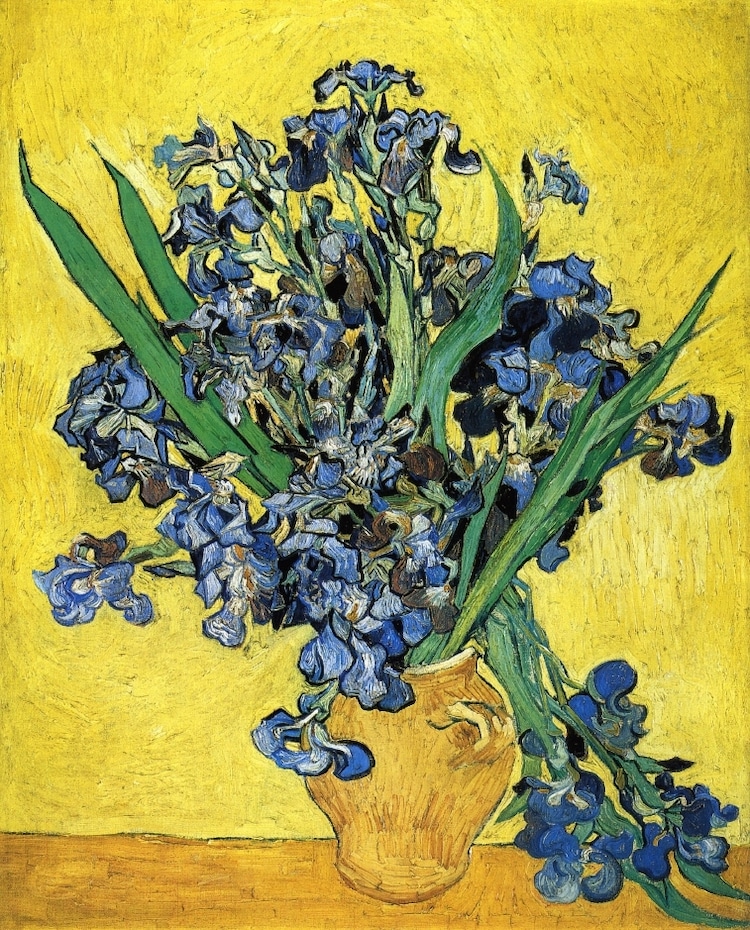
"Still Life with Irises" by Vincent Van Gogh. 1890.
By working with hue, value, and intensity—three building blocks of colors—artists tin tap into a broad range of emotions. In that location's zilch that changes an artwork's emotional impact more color. Masters like Van Gogh, Monet, and Toulouse-Lautrec all expertly manipulated color in their art to provoke different feelings. Color can be used symbolically or to create a design. Information technology can be selected for contrast or to set a specific mood. A deep understanding of colour theory helps whatever artist make better use of the colors they have at their disposal. The modern color wheel is a wonderful tool to utilise. It is designed to explain how colour is arranged and how each colour interacts with 1 another. At the centre of the color wheel y'all volition find the three primary colors and in the second circle, the secondary colors—two principal colors mixed. The very outer circle features the 3rd colors, the mixture of main color with an side by side secondary color.
Shape
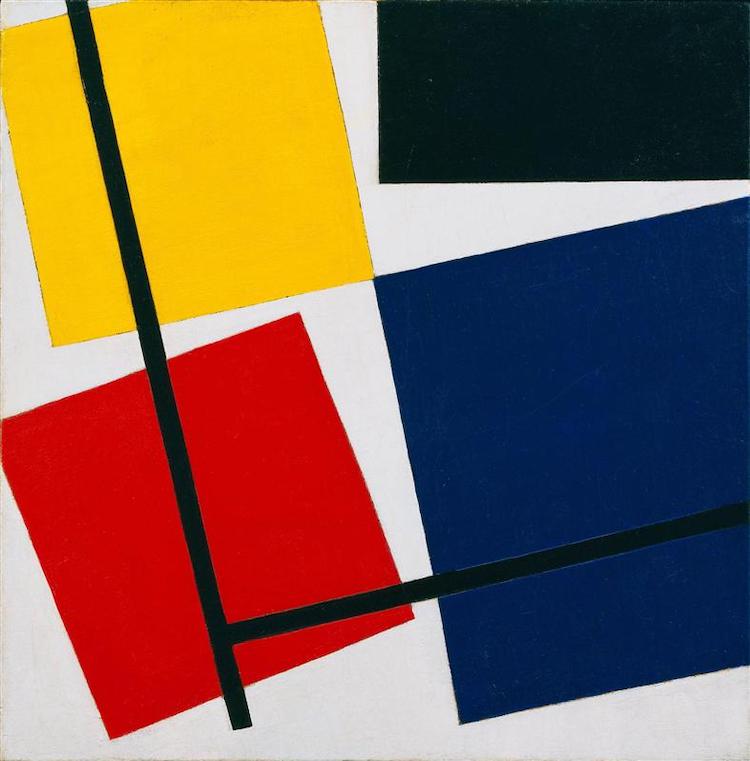
"Simultaneous Counter Composition" (1930) by Theo van Doesburg (Photo: Public domain via WikiArt)
The result of airtight lines, shapes are two-dimensional, flat, and only have tiptop and width. Geometric shapes similar circles and squares are mathematical and precise, while organic shapes take cues from nature and tend to be curved and abstract. Henri Matisse'southward collage fine art makes bully use of organic shapes, while Piet Mondrian is known for relying on geometric shapes in his paintings. Shapes can be used to command how we perceive a composition. For instance, triangles can help draw the eye to a particular point, while circles correspond continuity.
Class
When a shape acquires depth and becomes three-dimensional, and then it takes on form. Cylinders, pyramids, and spheres are some of the more common forms, though they can as well be amorphous. In sculpture, grade is of the utmost importance, though it tin can easily be introduced into drawing and painting using 3D fine art techniques. Baroque sculptor Bernini was a master of course, carving his sculptures in a way that gave enjoyment from whatever perspective. Class is also a large consideration in architecture, with acclaimed architects like Frank Lloyd-Wright, Zaha Hadid, and Tadao Ando giving careful consideration to this chemical element in their designs.
Value
Related to colour, value is the lightness and darkness of a color. The lightest value is white and the darkest value is blackness, with the departure between them divers equally the contrast. Playing with value can not merely alter sure forms, but also influence the mood of the artwork. Value is so important that the Italians created a term—chiaroscuro—that specifically refers to the utilise of low-cal and night in a slice of art. Bizarre painter Caravaggio was a master of usingchiaroscuroin his moody oil paintings. Photographer Ansel Adams is another example of an artist who expertly used value to his advantage past using areas of contrast to create interest in his landscape photography.
Space
This element of art tin be manipulated based on how an creative person places lines, shapes, forms, and color. The placement of these other elements creates space. Space can be either positive or negative. Positive space is an area occupied by an object or course, while negative space is an area that runs between, through, around, or within objects. Artists frequently recall about the foreground, middle ground, and background of their artwork, purposefully placing shapes and lines throughout the space to attain the perfect limerick. A sense of depth in two-dimensional works is oft accomplished by perspective, which itself can rely on lines or colors.
Texture
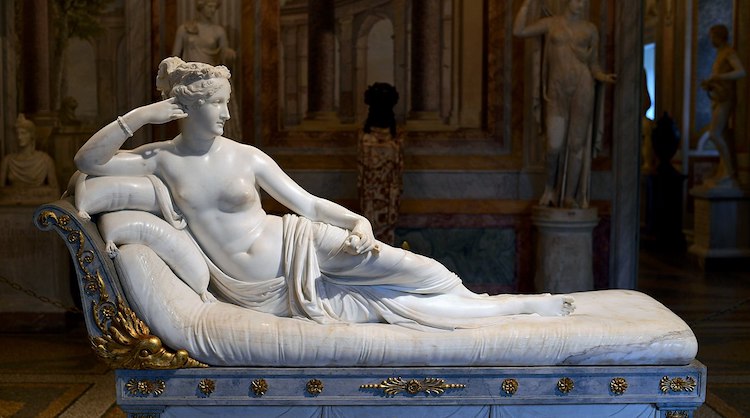
"Pauline Bonaparte as Venus Victrix" (1805-1808) past Antonio Canova. (Photograph: Public domain via Wikipedia)
Texture is an element of art that also plays to our sense of touch on. Information technology'due south defined as a description of the way something feels or looks like it would feel. Sometimes we're speaking near an actual texture that tin can exist felt, every bit in the case of Icelandic artist Hrafnhildur Arnardóttir, who creates installation art using synthetic pilus. Other times, the texture is an implied visual texture that is two-dimensional. Smooth, rough, hard, soft, hirsuite, fluffy, and bumpy are merely some different textures that evoke unlike responses.
For instance, an artist look for a hyperrealistic result would want clouds to appear fluffy, while some other creative person wishing to subvert conventions might play with texture to create a surreal experience for the viewer. 19th-century sculptor Antonio Canova was a master of this, as exemplified by his portrait of Napoleon's sis where she's resting on a cushion that seems and so soft and touchable, information technology's hard to believe that it's marble.
Inspired to start using the seven elements of art? Hither are some drawing lessons to aid get you lot started.
- Facial features are famously hard to draw: Learn how to draw whatever blazon of human nose with a few simple steps.
- Love fantasy art? Larn how to describe a unicorn or a dragon with these piece of cake, step-past-step instructions
- Optics are the window to the soul: Larn how to depict eyes in this sketching tutorial.
- Want to sketch your pet? Learn how to draw dogs in this step-by-step guide.
- Fascinated by insects? Learn how to draw a Monarch butterfly in v easy steps.
- H2o is an essential role of our lives, but how practice you depict this ambiguous compound? Learn how to depict water in 6 different means.
- Observe inspiration outdoors and learn how to draw three types of trees.
- People are some of the most fascinating and complex subjects to draw. While facial features capture the likeliness of a person, hair tin can say a lot about their personality. Larn how to draw different kinds of hair.
Want to learn more? Here are some online art classes we recommend.
- Portrait Drawing for Beginners: Learn how to draw anyone you'd like in bite-sized lessons that break downward the human confront into something simple and outgoing with this My Modern Met Academy Course.
- Architectural Illustration for Anybody: Draw architecture similar a pro in a pace-by-step process of drawing buildings using ink and colored pencils in this My Modern Met Academy Course.
- Beast Portraits in Colored Ink: Explore means to add personality and emotion to your work of art by using colored inks in this My Modern Met University Form.
- Light & Shading With Colored Pencils: Sharpen your drawing skills and create a cute floral compositions with this Craftsy course.
- Urban Sketching in xv Minutes a Twenty-four hours: Contain sketching into your daily routine with this Craftsy form.
- Realistic Textures in Colored Pencil: Learn how to draw ur and feathers in lifelike particular with this Craftsy course.
- Master Palettes: Explore color mixing and matching with oil paint Scott Gellatly in this grade.
- Learning Line: Larn how to utilize line drawing to reduce a subject down to its essential components in this course.
This article has been edited and updated.
Related Manufactures:
20 Art History Terms to Help You Skillfully Draw a Work of Fine art
11 Different Types of Painting That Every Creative person Should Know
10+ YouTube Channels to Acquire How to Describe for Free
Larn to Paint Without a Brush Past Drawing With Pastel Sticks
50+ Painting Ideas That Volition Inspire You to Selection Up a Brush Right Now
10 Essential Watercolor Techniques All Painters Demand to Know
Source: https://mymodernmet.com/elements-of-art-visual-culture/#:~:text=Line%2C%20color%2C%20shape%2C%20form,to%20be%20taken%20into%20consideration.
0 Response to "A Drawing With All the Elements of Art a Drawing With All the Elements of Art All in It"
Post a Comment